

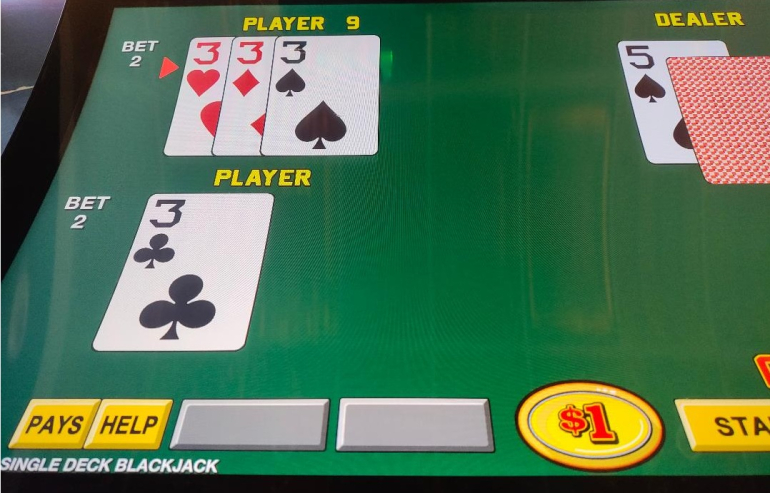
Many casino players treat basic strategy as an immutable set of commandments etched into a plastic card. They learn the rules for a standard shoe game, sit down at a pitch table, and assume the mathematics translate cleanly. While the fundamentals remain broadly similar, assuming that a single deck plays identically to a six-deck shoe is an expensive mistake.
Blackjack strategy is not a static list of opinions. It is the mathematical optimization of every possible hand against every dealer upcard. When the composition of the deck changes, the probabilities governing hits, stands, doubles, and splits shift as well. Understanding how and why basic strategy diverges between single-deck and six-deck games allows you to claw back every fraction of a percent against the house.
The Mathematical Engine: Why Deck Volume Dictates Strategy
The structural difference between a single-deck game and a six-deck shoe comes down to what mathematicians call the card removal effect.
In a single 52-card deck, removing just one card creates an immediate and dramatic impact on the composition of the remaining pool. When you hold an Ace and a King in single-deck play, two high-value cards are gone from a deck of 52. That represents nearly 4% of the total available cards and almost 10% of the game’s Aces. In a six-deck shoe containing 312 cards, removing that same Ace and King depletes less than 1% of the overall supply.
This mathematical reality shifts two critical levers:
First, your odds of receiving a natural blackjack are noticeably higher in a single-deck game. The probability of landing a natural 21 in a single deck is roughly 4.83%, whereas in a six-deck game it falls to approximately 4.75%. While that difference seems modest on paper, it produces a consistent upward drift in player expected value over thousands of rounds.
Second, the cards visible on the table tell you vastly more about what remains unseen in a single-deck game. If you hold a 10 and a 6 against a dealer showing a 10, three ten-value cards or neutral cards have been accounted for out of 52. That substantially lowers the odds that the dealer holds another 10 underneath, while also altering your exact chances of drawing a safe card. In a shoe, that information is diluted across hundreds of unplayed cards.
Because of this dynamic, single-deck strategy often relies on composition-dependent decisions, where the exact cards making up your hand matter just as much as the point total itself. Six-deck strategy, by comparison, relies almost exclusively on total-dependent decisions, treating any 16 the same whether it consists of an 8-8, a 10-6, or a 4-5-7.
Critical Doubling Deviations Between Shoe and Pitch Games
Doubling down is the primary tool players use to push money onto the layout when they hold a statistical edge. When transitioning from six decks to one, you can afford to play considerably more aggressively with several borderline hands.
Hard Totals: Hard 8, Hard 9, and Hard 11
In a standard six-deck shoe, you never double down on a Hard 8. The odds of catching a 10 to finish with an 18 are not high enough to compensate for taking only one card and doubling your wager. In a single-deck game that permits doubling on any first two cards, however, basic strategy tells you to double a Hard 8 against a dealer 5 or 6. Removing two low cards from a single deck tilts the balance of the remaining shoe toward high cards just enough to make an offensive push mathematically correct.
Hard 9 presents another sharp contrast. In a six-deck shoe, you only double a Hard 9 when the dealer shows a 3, 4, 5, or 6. If the dealer shows a 2, you simply hit. In a single-deck game, you double a Hard 9 against a dealer 2 through 6. A dealer showing a 2 is weak, and the concentration of high cards left in a single deck makes doubling your 9 against that 2 a positive-expectation play.
Hard 11 also displays subtle shifts depending on the house rules regarding the dealer hitting or standing on Soft 17. In six-deck games where the dealer stands on all 17s, you hit an 11 against a dealer Ace rather than doubling. In single-deck play, the power of an 11 is amplified: you double 11 against an Ace under almost all common rule variations because the diminished deck gives you an exceptional shot at converting your 11 into a 21 while leaving fewer Aces to help the dealer.
Soft Totals: Expanding Your Attack Zone
Soft doubling opportunities expand dramatically when you shed five decks from the shoe. Because an Ace can count as either 1 or 11, drawing a single card carries minimal risk of busting, and single-deck removal dynamics reward bold play against vulnerable dealer upcards.
-
Soft 13 and Soft 14 (Ace-2 and Ace-3): In a six-deck game, you only double these hands against a dealer 5 or 6. In a single-deck game, you expand that range to double against a 4, 5, or 6.
-
Soft 17 (Ace-6): In a six-deck game, you double against a 3 through 6. In single-deck, you double against a 2 through 6. Turning an Ace-6 into a double against a dealer 2 catches many casual players off guard, but the dealer’s high bust rate combined with the single deck’s density of ten-value cards makes it the mathematically optimal move.
-
Soft 18 (Ace-7): In a shoe, basic strategy dictates that you stand on Soft 18 against a dealer 2, doubling only against a 3 through 6. In a single-deck game, you double Soft 18 against a 2 through 6. Treating an 18 as an offensive launching pad against a dealer 2 is one of the most profitable strategic adjustments you can make.
-
Soft 19 (Ace-8): Under six-deck rules where the dealer hits Soft 17, doubling a Soft 19 is restricted exclusively to a dealer 6. In single-deck games with that same dealer rule, you double Soft 19 against both a 5 and a 6.
Splitting Pairs: When to Divide and Conquer
Pair splitting changes noticeably between single-deck and six-deck games, largely influenced by whether the table allows Double After Split (DAS). In modern shoe games, DAS is standard; in many single-deck games, casinos revoke DAS to protect their edge. Even when holding rule sets equal, the underlying deck math forces strategic divergences.
Low Pairs: 2s, 3s, and 6s
In a six-deck game without Double After Split, you hit a pair of 2s or 3s against a dealer 2 or 3, reserving your splits for dealer upcards of 4 through 7. In single-deck play without DAS, you split a pair of 2s and 3s against a dealer 3 through 7, and if DAS happens to be allowed, you split them against a 2 through 7.
A pair of 6s follows an identical trajectory of increased aggression. In multi-deck play without DAS, 6-6 is only split against weak dealer upcards of 3 through 6. In a single-deck environment, you split 6-6 against a 2 through 7 because the odds of drawing a 10 to turn one or both 6s into a workable 16, or pairing them with mid-range cards, work out far more favorably in a condensed card pool.
The 7-7 Dilemma
A pair of 7s yields a hard total of 14, one of the most awkward hands in blackjack. In a six-deck shoe, you split 7s against a dealer 2 through 7, and you hit against an 8, 9, 10, or Ace.
In single-deck play, the strategy against low cards remains identical, but the nuance sharpens against an 8. If the dealer shows an 8 in single-deck, you hit your 7s, but if the table allows surrender, 7-7 versus an 8 or 10 becomes an immediate candidate to abandon the hand. More importantly, when playing single-deck with DAS, splitting 7s against an 8 occasionally crosses the boundary into positive expectation depending on the specific house rules, though hitting remains the universal standard when DAS is absent.
Hitting and Standing: The Composition-Dependent Decisions
The most striking divergence between single-deck and six-deck blackjack occurs in marginal hit-or-stand scenarios. In a multi-deck shoe, basic strategy charts assume you know nothing about the cards except your point total and the dealer upcard. In single-deck, the specific cards in your hand provide actionable intelligence.
The Famous Hard 16 vs. Dealer 10
Holding a 16 against a dealer 10 is the worst hand in blackjack. In a six-deck game, total-dependent strategy is unambiguous: if surrender is not available, you hit. You will bust roughly 62% of the time, but hitting loses slightly less money in the long run than standing.
In a single-deck game, that rule fractures. If your 16 is composed of a 10 and a 6, basic strategy instructs you to stand.
The rationale reveals the elegance of probability. Holding a 10 and a 6 removes one of the game’s four 6s from play, reducing the supply of cards that could convert your hand into a winning 21. Simultaneously, holding a 10 removes a vital card from the deck that could bust you, but it also marginally reduces the probability that the dealer’s face-down card is a 10. That delicate swing tilts the math: standing becomes less costly than hitting. However, if your 16 consists of a 9 and a 7, or three lower cards like a 4, 5, and 7, you revert to hitting because none of the critical 5s or 6s have been drained from the deck.
Hard 12 vs. Dealer 3 and 4
Standing on a 12 against a dealer 4, 5, or 6 is standard doctrine across all multi-deck shoes. Against a dealer 3, shoe strategy mandates hitting.
In single-deck play, composition once again drives the decision. While standard total-dependent charts suggest hitting a 12 against a 3, a hand composed of 10 and 2 against a 3 is a clear hit, whereas a 12 composed of 8 and 4 or 7 and 5 can lean toward standing under specific rule sets. When you hold two small cards, you have depleted the deck of low values that would otherwise save you on a hit, making a bust significantly more probable.
Table Rules That Warp the Single-Deck Advantage
A pure single-deck game played with liberal rules offers a house edge of less than 0.15%, making it the closest thing to an even game in the entire casino. Casinos are acutely aware of this math, and they have spent decades modifying table rules to neutralize the player’s edge.
Before you apply single-deck basic strategy, you must audit the table conditions:
-
The 6:5 Payout Trap: Never play a single-deck table that pays 6:5 on a natural blackjack. A standard 3:2 payout awards $15 on a $10 bet; a 6:5 payout awards only $12. That seemingly small rule change adds roughly 1.39% directly to the house edge, completely obliterating any mathematical advantage gained from playing a single deck. A six-deck shoe paying 3:2 is drastically superior to a single-deck table paying 6:5.
-
Double Down Restrictions: Many single-deck games restrict doubling to totals of 10 or 11 (D10-11), or totals of 9, 10, and 11 (D9-11). If you cannot double on an 8 or on soft hands, half of the strategic power of a single deck is stripped away.
-
Dealer Hits Soft 17 (H17): Single-deck games almost universally mandate that the dealer hit Soft 17. This rule adds approximately 0.19% to the house edge compared to games where the dealer must stand (S17). When H17 is in effect, your basic strategy must incorporate additional double downs, such as doubling an 11 against an Ace.
Aligning Your Strategy with the Shoe
Transitioning between single-deck and six-deck blackjack requires deliberate mental recalibration. In a six-deck shoe, your strategy is defensive and robotic: trust the total-dependent chart, limit your soft doubles to premium spots, and never deviate on hard hands like 16 versus 10.
In a genuine single-deck game, your strategy becomes aggressive and opportunistic. You push more money onto the table with borderline hands like Hard 8 and Soft 18, exploit weak dealer upcards with wider split ranges, and pay sharp attention to the specific card values resting in front of you. Mastering these precise tactical divergences ensures you extract maximum value from every hand you play.

Comments are closed.